





An e-bike doesn’t move from “working” to “broken” in a straight line. It drifts through a middle phase where nothing has failed, but the system is no longer behaving the way it should.
That phase is easy to miss because the bike still functions. You can still ride it. The problem is that what you’re feeling during that stage isn’t random variation. It’s the system compensating for something that has already started to degrade.
If you understand what those changes actually represent, you can usually stop a small issue from turning into a multi-component repair.
The System Perspective Most Riders Don’t Use
An e-bike is not just a motor attached to a bicycle. It’s a closed electrical and mechanical loop.
The battery supplies energy.
The controller regulates how that energy is delivered.
The motor converts it into torque.
Sensors feed real-time input back into the controller.
Every ride is a constant adjustment process.
When one part begins to operate outside its normal range, the rest of the system doesn’t shut down. It adapts. That adaptation is what changes the feel of the ride.
The key point here is that performance doesn’t drop immediately. Efficiency does.
Why “Less Power” Is Usually the Wrong Diagnosis
A rider will often describe the first issue as a loss of power, especially on inclines. In practice, the system rarely loses raw power early on. What changes is how cleanly that power is delivered.
There are two common reasons for this:
Voltage instability under load
A battery that appears fine at rest can struggle when current demand increases. Internal resistance rises over time, which causes voltage sag during acceleration or climbing.
Controller inefficiency
The controller may no longer regulate current smoothly. Instead of a steady flow, the motor receives uneven input.
The motor responds by drawing more current to maintain torque. That increases heat and electrical stress. Over time, that stress accumulates inside the motor.
This is how problems that eventually require Ebike motor repair often begin. Not with a failed motor, but with a system that has been feeding it inconsistent conditions.
Delayed Assistance Is a Signal Chain Problem
A slight delay between pedalling and assistance doesn’t come from the motor. It comes from how information is processed.
The controller depends on:
- accurate sensor input
- stable voltage
- predictable timing
If any of these are off, even slightly, response time changes.
For example, a torque sensor that is drifting out of calibration may still send data, but not with the same accuracy or timing. The controller then hesitates before delivering power because the input is less reliable.
This creates a delay that feels minor but has a larger impact. It changes how load is introduced into the system, especially during starts and inclines. Over time, that uneven load contributes to wear in components that were never designed to operate under those conditions.
Why Inconsistent Behaviour Is More Important Than Failure
A bike that stops working is straightforward to diagnose. A bike that behaves differently depending on conditions is not.
If performance changes based on ride duration, temperature, or terrain, you are looking at a system that is sensitive to operating conditions. That sensitivity usually comes from one of two places:
Thermal variation
Components behave differently as they heat up. Electrical resistance increases, and controller efficiency can drop.
Connection integrity
Small increases in resistance at connectors or wiring points only show up under load.
This is not unique to e-bikes. It’s a pattern seen in other electric systems as well, including what technicians deal with in an E scooter repair shop. Intermittent faults follow conditions, not randomness.
Ignoring that pattern allows the issue to stabilise at a worse level or develop into a permanent fault.
Ebike Motor Repair: Why the Motor Often Takes the Hit
By the time a motor shows clear symptoms, the underlying issue has usually been present for some time.
The motor is the final stage in the power chain. It doesn’t decide how power is delivered; it reacts to it. If it receives unstable or inefficient input, it compensates by increasing current draw.
That leads to:
- higher internal temperatures
- increased wear on windings and bearings
- reduced efficiency over time
This is why Ebike motor repair is often the result of prolonged system imbalance rather than a standalone failure. The motor absorbs the consequences of upstream issues.
Catching the problem when it first appears as uneven torque or hesitation keeps the repair focused. Waiting until there is noise, vibration, or complete power loss usually means the damage is already established.
Ebike Brake Repair: Small Changes That Affect the Whole Ride
Braking is often treated as a simple wear-and-replace component, but in an e-bike, it interacts with the rest of the system more than people realise.
When power delivery becomes inconsistent, weight transfer during acceleration changes. That affects how the bike settles when braking. You might notice:
- slightly longer stopping distances
- less predictable braking response
- uneven feel between front and rear
At first, this might be just pad wear or minor misalignment. But if left alone, it creates uneven stress across the braking system.
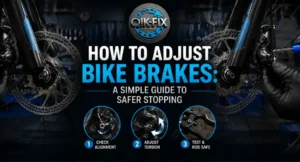
Timely Ebike brake repair corrects these small imbalances before they affect overall control. It also prevents secondary wear that can spread to rotors and mounting points.
How One Small Issue Becomes Several
The important shift to understand is this: problems in an e-bike don’t stay local.
A controller that delivers uneven current affects the motor.
A motor under stress increases load on the battery.
A system under uneven load changes how the bike behaves mechanically, including braking.
This is why a bike that felt “slightly off” can later require work across multiple components. The original issue triggered a chain of adjustments that gradually pushed other parts out of their normal operating range.
This pattern is consistent across electric systems, including what’s seen in an E scooter repair shop. Early-stage inefficiencies tend to spread if they’re not addressed.
What You Should Actually Pay Attention To
Instead of looking for obvious failures, focus on changes in behaviour under the same conditions.
Pay attention if:
- the bike feels different on a route you ride regularly
- assistance is less predictable than before
- performance changes during a single ride
- small inconsistencies are becoming more frequent
These are not isolated symptoms. They are indicators that the system is no longer balanced.
Why Timing Changes the Cost of Repair
There’s a clear difference between correcting a system and repairing damage.
Early-stage issues involve:
- calibration
- minor component adjustments
- isolated part replacement
Later-stage issues involve:
- multiple affected components
- accumulated wear
- more complex diagnostics
The difference in cost comes from how long the system has been operating inefficiently, not just what part has failed.
Where a Specialist Makes the Difference
Diagnosing these early changes requires looking at the system as a whole, not just individual components.
Workshops that deal with electric systems regularly, including those that also operate as an E scooter repair shop, tend to approach faults differently. Instead of replacing parts based on symptoms, they trace how power and signals are moving through the system.
That approach is what keeps small issues from becoming larger ones.
A Practical Takeaway
If an e-bike starts to feel different, that change has a cause. It may not be obvious, and it may not stop the bike from working, but it won’t correct itself.
Addressing it early keeps the problem contained. Ignoring it allows the system to adapt in ways that increase stress elsewhere.
If you’re in Coventry or the West Midlands and something about your e-bike feels off, getting it checked by a specialist who understands how these systems behave under real conditions can save you from dealing with a much more involved repair later.
A proper diagnosis at the right time doesn’t just fix the issue. It prevents it from spreading.