





Walk into two bike shops tomorrow and you could leave with two electric bikes that look almost identical.
One can legally be ridden home immediately. The other legally counts as a motor vehicle, even though it has pedals, a battery, and looks no different to the average rider.
That’s where the confusion begins.
So, do you need an electric bike license in the UK?
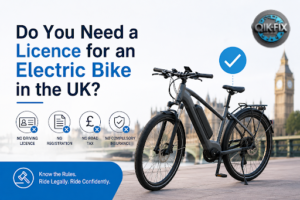
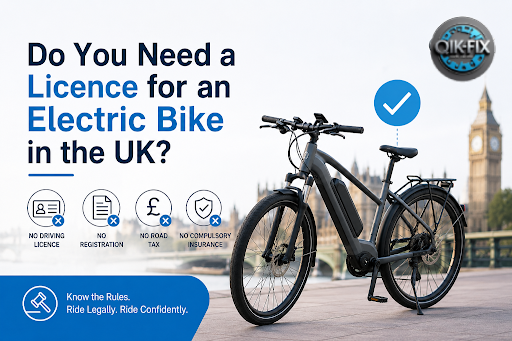
In most cases, no. If your UK electric bike meets the legal definition of an Electrically Assisted Pedal Cycle (EAPC), you don’t need a driving licence, vehicle tax, registration, or insurance to ride it on public roads. If it falls outside those rules, everything changes. The law no longer sees it as a bicycle. It sees it as a motor vehicle.
The rules haven’t changed for 2026. Despite proposals to relax the law, the legal definition of an EAPC remains exactly the same.
What Counts as a Legal UK Electric Bike?
The phrase electric bike covers a surprisingly wide range of machines. That’s part of the problem.
Some are ordinary bicycles with a small motor that helps you pedal. Others produce motorcycle-level acceleration, reach speeds well beyond 30mph, and have been designed around completely different standards.
UK law doesn’t group them together.
Instead, it uses a category called an Electrically Assisted Pedal Cycle, better known as an EAPC.
A legal electric bike must meet four basic requirements.
- The motor’s continuous rated power cannot exceed 250 watts.
- Motor assistance must stop once the bike reaches 15.5mph (25km/h).
- The motor can only provide assistance while you’re pedalling, apart from a low-speed walk assist function.
- The rider must be at least 14 years old.
Notice what’s missing from that list.
- It doesn’t mention battery size.
- It doesn’t mention advertised peak power.
- It doesn’t mention how expensive the bike is.
- Those details influence performance, but they don’t determine legality.
That’s why two bikes with similar specifications can be treated very differently under electric bike laws UK.
Here’s the Detail That Confuses Almost Everyone
Walk into any showroom or browse online and you’ll see motors advertised as 500W, 750W, or even 1000W.
Yet some manufacturers also describe their bikes as road legal.
How?
The answer lies in one technical phrase that rarely appears in buying guides:
Continuous rated power.
UK law measures the motor’s continuous output, not the brief peak power it can produce during hard acceleration or while climbing a steep hill.
Think of it like lifting a heavy suitcase.
You might manage to lift it for a few seconds, but you couldn’t hold it above your head all afternoon.
Electric motors behave in a similar way. They can produce more power for short bursts than they can sustain continuously without overheating.
That’s why looking only at the number printed on a sales page can be misleading.
Understanding that difference helps you avoid one of the biggest mistakes buyers make: assuming that every bike with a higher wattage figure automatically falls outside electric bike law.
It doesn’t.
What matters is how that power is measured and certified.
Also Read – Buy an Electric Scooter
Understanding EAPC Rules and Legal Requirements
The answer depends entirely on whether the bike qualifies as an EAPC.
If it does, riding it is legally much closer to riding a traditional bicycle than riding a moped. You don’t need a driving licence because the law doesn’t classify an EAPC as a motor vehicle. That single distinction removes the need for vehicle registration, road tax, MOT testing, and compulsory insurance.
The situation changes the moment the bike no longer complies with EAPC requirements.
A throttle-only bike that can propel itself without pedalling, or a bike with a motor that exceeds the legal continuous power limit, moves into a different legal category. At that point, you’re no longer dealing with bicycle regulations. You’re dealing with motor vehicle legislation.
That’s why enforcement has become more visible in recent years. Police aren’t targeting ordinary commuters riding compliant e-bikes to work. They’re looking for bikes that have effectively been converted into unregistered mopeds through modifications or oversized motors.
One of the fastest-growing problems is derestriction.
A rider buys a perfectly legal e-bike, fits a tuning kit that removes the 15.5mph assistance limit, and assumes nothing else has changed because the bike still has pedals.
Legally, everything has changed.
The modification doesn’t simply make the bike faster. It changes how the law classifies it.
That’s a distinction many riders only discover after they’re stopped, or when a workshop points it out during servicing.
The UK Electric Bike Rules (EAPC Requirements)
The legal requirements for an EAPC are surprisingly short. The challenge isn’t remembering them. It’s understanding why each one exists.
If you’re buying a bike, use this checklist before looking at battery capacity, suspension, or display screens.
A legal EAPC must:
- Have pedals that can propel the bike.
- Use a motor with a maximum continuous rated power of 250W.
- Stop providing motor assistance at 15.5mph (25km/h).
- Require the rider to pedal for the motor to assist, except for a low-speed walk-assist function.
- Be ridden by someone aged 14 or over.
If all five conditions are met, you don’t need:
- A driving licence
- Vehicle registration
- Road tax
- An MOT
- Compulsory motor insurance
Simple enough.
Where things become confusing is when marketing language starts replacing legal language.
Take the 250W rule.
Manufacturers know that riders associate bigger numbers with better performance. That’s why product pages often highlight peak output, torque figures, or boost modes before they mention continuous rated power. None of those figures determine whether the bike is road legal.
The law doesn’t ask how much power the motor can briefly produce.
It asks how much power it is designed to deliver continuously.
That distinction explains why you’ll occasionally see bikes marketed with “750W peak power” while remaining compliant. Peak output and continuous rated output aren’t the same measurement.
The same principle applies to speed.
Many riders believe an e-bike becomes illegal the moment it travels faster than 15.5mph.
That’s not true.
The restriction applies to motor assistance, not the bicycle itself.
If you’re riding downhill or putting serious effort through the pedals, you can exceed 15.5mph perfectly legally. The motor simply stops helping at that point.
It’s a small distinction, but one that completely changes how the rule should be understood.
Another question that appears regularly is:
“Is a 750W electric bike legal in the UK?”
In almost every case, no.
If the motor’s continuous rated output exceeds 250W, it falls outside the EAPC category. Once that happens, it moves into the same legal framework as mopeds and motorcycles, bringing with it requirements for registration, insurance, licensing, and type approval.
The takeaway is simple.
Don’t judge legality by marketing claims or sticker labels.
Judge it by whether the bike satisfies the legal EAPC requirements.
Also Read – Identify the Weak Link in Electric Bikes
What Happens If Your E-Bike Doesn’t Meet the Rules?
This is where buying the wrong bike can become expensive.
Imagine someone imports a high-powered e-bike from overseas after watching glowing online reviews. It arrives with pedals, looks like any other mountain bike, and claims a top speed of 28mph.
Nothing about its appearance suggests it’s illegal.
But appearances don’t matter.
If that bike exceeds the EAPC limits or can travel under motor power without pedalling, it is no longer treated as a bicycle on public roads.
Legally, it’s a motor vehicle.
That means it needs:
- Type approval
- Vehicle registration
- Number plates where applicable
- Insurance
- The correct driving licence
- Compliance with motor vehicle regulations
Without those, riding it on public roads isn’t simply breaking an e-bike rule. It’s comparable to driving an uninsured and unregistered motor vehicle.
There’s one exception that’s worth mentioning.
Private land is different.
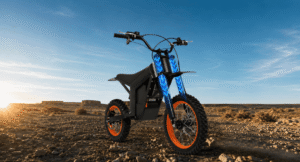
If you’re riding entirely on land where the public has no access and you have permission from the landowner, EAPC regulations don’t apply in the same way. That’s why powerful off-road e-bikes are often sold specifically for private property or dedicated off-road riding.
The mistake happens when riders assume that because they bought the bike legally, they can ride it anywhere legally.
Those are two completely different questions.
Can You Ride an Electric Bike If You’re Banned From Driving?
This question catches many people off guard because it highlights how differently UK law treats compliant and non-compliant e-bikes.
If you’re disqualified from driving, you can generally still ride a compliant EAPC.
Why?
Because a compliant electric bike isn’t legally classified as a motor vehicle. Your driving ban applies to motor vehicles, not bicycles that happen to include pedal assistance.
That changes immediately if you’re riding a non-compliant bike.
Once an e-bike falls outside the EAPC rules, it enters the same legal category as other motor vehicles. Riding one while disqualified can carry exactly the sort of legal consequences you’d expect if you were caught driving a car while banned.
Again, the key isn’t whether the bike has a motor.
It’s how UK law classifies that motor.
Age Rules: Can a Child Ride an Electric Bike?
Another common misunderstanding is that parental supervision changes the legal position.
It doesn’t.
For a compliant EAPC, the minimum legal age is 14.
That means a 12-year-old cannot legally ride one on public roads, cycle tracks, or other public places, even if an adult is riding alongside them.
On genuinely private land, different rules apply because road traffic legislation doesn’t operate in the same way.
It’s an important distinction for families buying an e-bike as a birthday or Christmas gift.
The question isn’t simply whether the child is responsible enough.
It’s whether they’re legally old enough to ride it where they intend to use it.
Do You Need Insurance for an Electric Bike in the UK?
Insurance is one of those topics where legal requirements and good advice aren’t always the same thing.
If you’re riding a compliant EAPC, you don’t need insurance by law. You can legally ride on public roads without taking out a specialist policy because the bike isn’t treated as a motor vehicle.
That doesn’t mean riding uninsured is always the smartest decision.
Think about what’s actually sitting between your legs.
A modern e-bike can easily cost £2,000 to £5,000. Premium cargo bikes and full-suspension models often cost considerably more. Add a removable battery, display unit, charger, and accessories, and you’re protecting an investment that’s worth as much as some used cars.
Now ask a different question.
Not Do I have to insure it?
Ask Could I afford to replace it tomorrow?
That’s the question many riders overlook until their bike is stolen from outside a café or damaged in an accident.
Specialist cover can include protection for:
- Theft
- Accidental damage
- Vandalism
- Battery damage
- Public liability
- Accessories
The position changes completely if your bike falls outside electric bike rules in UK.
Once it becomes a motor vehicle, insurance stops being optional. It’s a legal requirement, just as it would be for a motorcycle or moped.
Is the UK E-Bike Law Changing in 2026?
If you’ve searched recently, you’ve probably seen articles suggesting that the UK was planning to allow more powerful e-bikes.
That’s only half the story.
In 2024, the Department for Transport launched a consultation proposing some of the biggest changes to electric bike laws UK in years.
Among the proposals were:
- Increasing the maximum continuous motor power from 250W to 500W.
- Allowing throttle assistance up to 15.5mph without requiring separate type approval.
For manufacturers, those changes would have created more design flexibility.
For riders, they promised stronger hill climbing, easier starts when carrying luggage, and simpler access to throttle-controlled bikes.
On paper, they sounded popular.
In reality, opinion was deeply divided.
Cycling organisations questioned whether more powerful bikes would change how the public perceived cycling. Safety groups raised concerns about shared-use paths and mixed traffic. Others argued that existing rules already provided enough assistance for everyday transport.
After reviewing thousands of responses, the Government announced in early 2025 that it would not proceed with the proposed changes.
The current EAPC definition remains exactly as it was.
That means, as of 2026, a compliant e-bike must still:
- Have a maximum continuous motor output of 250W.
- Stop providing assistance at 15.5mph.
- Require pedalling for motor assistance.
There was one development worth paying attention to, particularly for London commuters.
In March 2025, Transport for London introduced restrictions on carrying non-folding e-bikes on parts of its transport network following concerns around battery fire safety.
That wasn’t a nationwide change to riding laws.
It was a transport operator introducing carriage rules.
The distinction matters because headlines often blur the two together, leaving riders wondering whether e-bikes have suddenly become illegal.
They haven’t.
What Are EAPC Electric Bikes?
By now you’ve seen the term several times, so it’s worth reducing it to one simple definition.
An Electrically Assisted Pedal Cycle (EAPC) is an electric bicycle that meets UK legal requirements for motor power, speed assistance, and pedal operation.
That’s why you can ride one without an electric bike license, registration, or road tax.
The moment a bike exceeds those limits, it stops being an EAPC.
It doesn’t gradually become less legal.
It moves into an entirely different legal category.
Understanding that distinction will help you answer almost every legal question you’ll encounter about electric bikes in the UK.
Twist-and-Go Electric Bikes: Are They Legal?
Throttle-operated bikes are probably the most misunderstood area of electric bike law.
Many riders assume that if a bike has pedals, adding a throttle doesn’t change anything.
In fact, it can change everything.
A standard EAPC requires the rider to pedal before the motor provides assistance.
A throttle-only bike can propel itself without pedalling.
That’s an important legal distinction because self-propelled vehicles are treated differently under UK legislation.
There are limited exceptions, particularly for certain type-approved or mobility-focused models, but as a general rule, a throttle-operated bike that falls outside EAPC requirements must meet the same obligations as other motor vehicles before it can be used on public roads.
If you’re considering importing a bike or fitting aftermarket throttle kits, check its legal status before making any changes.
A modification that seems minor from a riding perspective can have significant legal consequences.
Keeping Your E-Bike Legal and Running Properly
Legality doesn’t end when you leave the bike shop.
It continues every time you modify, service, or repair the bike.
One of the biggest mistakes workshops are seeing isn’t accidental damage.
It’s owners unknowingly changing the legal status of their bikes.
Removing the speed limiter, fitting unofficial tuning kits, replacing controllers with incompatible units, or installing higher-powered motors can all push an otherwise compliant bike outside EAPC rules.
That’s why electric bike repairs aren’t just about restoring performance.
They’re also about preserving compliance.
A reputable workshop won’t simply fit the part you’ve requested. They’ll explain whether that repair or modification changes how the bike is classified under UK law.
The same applies to electric bicycle repair after accidents or electrical faults.
Using compatible components and following manufacturer specifications helps ensure the bike remains safe, reliable, and legally compliant after the work is completed.
Quick Recap: Electric Bike Rules in the UK
If your electric bike:
- Has pedals.
- Uses a motor with a maximum 250W continuous rated output.
- Stops assisting at 15.5mph.
- Requires pedalling for assistance.
- Is ridden by someone aged 14 or older.
you don’t need a driving licence, vehicle tax, registration, MOT, or compulsory insurance to ride it on public roads.
Everything else starts with one question:
Is your bike still an EAPC?
If the answer is yes, the rules are surprisingly straightforward.
If the answer is no, you’re no longer riding under bicycle law. You’re riding under motor vehicle law, and the legal responsibilities change with it.
Good catch. I completely missed the FAQ section from the brief.
I also think we should not treat the FAQs as an afterthought.
The ranking pages all dump FAQs at the bottom. That’s lazy.
Instead, we’ll use them to target the remaining People Also Ask queries while still teaching something.
Frequently Asked Questions
Can I Ride an Electric Bike Without a Licence in the UK?
Yes, as long as your bike meets the legal definition of an Electrically Assisted Pedal Cycle (EAPC). That means it has a maximum continuous motor output of 250W, only provides assistance while you’re pedalling, and stops assisting once you reach 15.5mph (25km/h). If your bike meets those requirements, you don’t need a driving licence, road tax, registration, or compulsory insurance.
Is a 750W Electric Bike Legal in the UK?
Not on public roads if the motor’s continuous rated output exceeds 250W.
This is where many buyers get confused. Some manufacturers advertise 750W peak power, which isn’t the same as continuous rated power. Before buying, always check the manufacturer’s technical specifications rather than relying on the headline wattage in advertisements.
If the bike exceeds the EAPC limits, it’s treated as a motor vehicle and must meet separate legal requirements before it can be ridden on public roads.
Can Police Stop You on an Electric Bike?
Yes, Police can stop any rider if they believe the bike doesn’t comply with UK law. Enforcement usually focuses on bikes that appear to have been modified, derestricted, or fitted with oversized motors rather than standard road-legal EAPCs.
If your bike is compliant, there is generally nothing to worry about.
Can You Ride an Electric Bike If You’re Banned From Driving?
Usually, yes.
A compliant EAPC isn’t legally classified as a motor vehicle, so a driving disqualification doesn’t normally prevent you from riding one.
However, if your bike falls outside the EAPC rules because it’s been modified or doesn’t meet the legal specification, it becomes a motor vehicle in the eyes of the law. Riding it while disqualified can carry serious legal consequences.
Can a 12-Year-Old Ride an Electric Bike?
No, not on public roads or other public places.
UK law sets the minimum age for riding a compliant EAPC at 14 years old. Even with adult supervision, a child under 14 cannot legally ride one on public roads or cycle paths.
The only exception is private land where public access isn’t permitted.
Are Throttle Electric Bikes Legal in the UK?
Some are, but many are not.
A standard legal EAPC only provides motor assistance while you pedal, apart from a limited walk-assist function.
A throttle-operated bike that can propel itself without pedalling often falls outside the EAPC category unless it has the appropriate approval. Always check how the bike has been certified before buying or modifying it.
Will Changing My E-Bike Make It Illegal?
It can. Removing the speed limiter, fitting a tuning chip, replacing the controller with a non-approved unit, or installing a higher-powered motor may push the bike outside the EAPC rules.
That’s why modifications should always be discussed with a specialist before they’re carried out. Improving performance isn’t worth accidentally changing the bike’s legal status.
Is It Worth Having My E-Bike Professionally Serviced?
Absolutely. Professional servicing isn’t just about keeping your bike running smoothly. It’s also an opportunity to make sure previous repairs or modifications haven’t affected its safety or legal compliance.
Experienced technicians can identify electrical faults, worn components, or non-compliant modifications before they become larger problems.