







One day your electric scooter charges without any problems, and the next day you plug it in and nothing happens. It’s easy to blame the battery, but that’s not always where the fault lies.
A faulty charger, a damaged charging port, a blown fuse, or a battery management system (BMS) fault can all stop a scooter from charging, and several of these faults are far simpler and cheaper to fix than replacing the battery.
In this guide, we’ll walk through the most common causes, how to tell them apart, and why a proper diagnosis, not a guess, is the fastest way to get your scooter charging again.
Quick Diagnosis: Is It the Charger, Port, or Battery?
In our experience of diagnosing scooters across Coventry, the battery is almost always the prime suspect, but it’s rarely the actual culprit.
- A charger’s indicator light that stays off, even in a working socket, or behaves differently than usual, is often a sign the fault lies outside the scooter itself.
- Dirt, moisture, bent pins, or a loose connection at the charging port can just as easily stop the charger from making proper contact.
- And if your model has a fuse, a blown one interrupts the charging circuit completely, making the scooter appear as though it isn’t receiving any power at all.
- Any of these can look identical to a dead battery from the outside, which is exactly why we check all of them before pointing to the battery.
- If the battery itself is swollen, unusually hot, leaking, or has a strong chemical smell, disconnect the charger immediately and get a diagnostic before risking your safety.
Some scooters also stop charging when the battery management system (BMS) enters protection mode after a deep discharge.
A BMS reset needs to be done carefully to avoid masking a deeper fault or damaging the battery further, so it’s best carried out as part of a proper diagnostic rather than attempted at home; especially if it keeps happening, which usually means the protection system is reacting to another fault rather than causing it.
Also Read: Why You Shouldn’t Ignore Small Changes in Your E-Bike
Common Causes of an Electric Scooter Not Charging
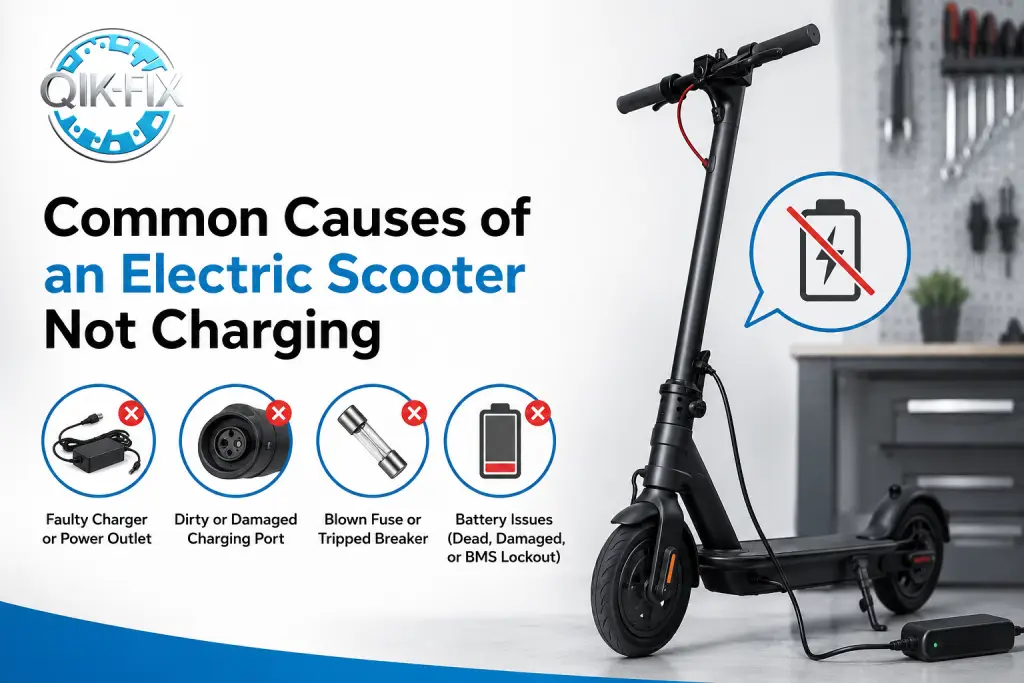
A scooter rarely stops charging for no reason. Sometimes the problem develops gradually through wear and tear.
Sometimes it happens after water gets into the charging port, the charger cable is damaged, or the battery has been left fully discharged for too long.
The difficulty is that several different faults can produce the same symptom: a scooter that simply won’t charge.
That’s why replacing parts without first confirming the cause often costs more than properly diagnosing the problem in the first place.
Faulty Charger or Power Outlet
A charger fault can be hard to spot with the naked eye. Cables often look fine while the internal components have already failed.
Testing with a second charger can help narrow things down, but it’s a risky shortcut: an incompatible charger, even one that looks similar, can damage the battery management system and turn a simple fault into an expensive one.
We test charger output directly on-site, so you get a definite answer without the guesswork.
Dirty or Damaged Charging Port
The charging port is one of the few parts of a scooter that’s exposed every time it’s used, so it’s no surprise that it causes its fair share of charging problems.
UK weather is notoriously tough on charging ports. Road salt, wet commutes, and daily wear can easily coat or bend the internal pins.
We’ve also seen ports loosen over time or connector pins become bent after repeated use, making charging unreliable or preventing it altogether.
If the connector doesn’t slide in smoothly, don’t force it. Forcing a stiff connection is one of the fastest ways to bend a pin or crack the housing. It’s far better to have the port inspected properly than risk turning a cleaning job into a replacement.
Blown Fuse or Tripped Breaker
Some electric scooters include a fuse to protect the charging circuit from electrical faults. If that fuse blows, power can’t reach the battery, so the scooter simply won’t charge.
A blown fuse is rarely the whole story; it’s usually a symptom of another electrical fault rather than the root cause. Fitting the wrong rating, or replacing it without finding out why it blew, can quickly lead to it happening again, or worse.
If a fuse keeps blowing, that’s a sign of another electrical fault somewhere in the system, one that needs diagnosing properly, rather than fitting replacement after replacement.
Battery Issues (Dead, Damaged, or BMS Lockout)
Battery failures do happen, but they’re far from the only reason an electric scooter stops charging.
Lithium-ion batteries gradually lose performance as they age, especially if they’re regularly run completely flat, stored for long periods without charging, or exposed to extreme temperatures.
At the same time, the battery management system constantly monitors battery health and will shut charging down if it detects unsafe voltage levels or another condition that could damage the battery.
The important thing is that a faulty charger, a damaged charging port, and a BMS lockout can all look exactly like a failed battery.
That’s why we always diagnose the charging system first before recommending replacement parts. It’s a more reliable way to find the real fault, and often saves replacing components that were never the problem to begin with.
Electric Scooter Not Charging Fully? Here’s Why
Sometimes the scooter does charge, but only to 60%, 80%, or another point before it stops. That usually points to a different issue than a scooter that won’t charge at all.
As lithium-ion batteries age, the individual cells don’t always wear at the same rate. The battery management system (BMS) monitors those cells and may stop charging early if it detects a voltage imbalance or another condition that could damage the battery.
The result is a scooter that appears fully charged even though it isn’t reaching its normal range.
Charging habits can also play a part. Frequently running the battery completely flat, leaving it discharged for long periods, or using an unsuitable charger can reduce battery performance over time.
If your scooter has always charged to 100% and suddenly starts stopping well short of that, don’t assume the battery needs replacing. A proper diagnosis can determine whether the issue lies with the battery pack, the charger, or the charging system itself.
Charger Light Stays Green, But Scooter Won’t Charge: What It Means
A charger light that stays green usually tells you the battery is fully charged. If the scooter isn’t charging at all, that signal can point to a fault elsewhere.
One possibility is that the charger isn’t making proper contact because the charging port is damaged, loose, or contaminated with dirt.
Another is that the battery management system isn’t allowing current into the battery, so the charger incorrectly assumes charging is complete.
We’ve also seen chargers develop internal faults where the indicator light appears normal even though they’re no longer delivering enough power to charge the battery.
This is why the charger light alone shouldn’t be used to diagnose the problem. It only shows what the charger believes is happening, not necessarily what’s happening inside the scooter.
That’s why we check the charger, charging port, and battery together rather than relying on the indicator light alone. It’s the only way to get a reliable answer instead of a guess.
How to Fix an Electric Scooter That’s Not Charging
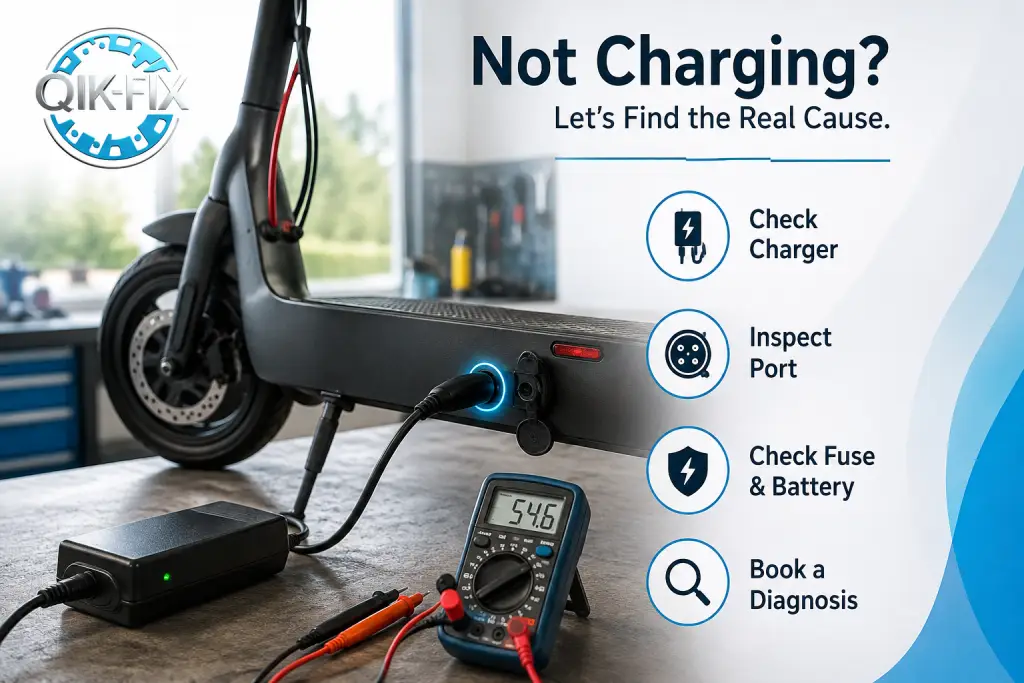
Before replacing the battery or ordering new parts, work through the charging system one step at a time. Charging faults often have a much simpler cause than they first appear, and confirming where the problem starts can save both time and money.
Also Read: How to Accurately Identify the Weak Link in Electric Bikes
When should you stop troubleshooting?
Stop trying to charge the scooter if the battery is swollen, leaking, unusually hot, has a burning smell, or you notice melted connectors or signs of water damage. These are signs of a potentially unsafe battery or electrical fault. Disconnect the charger and have the scooter inspected before using it again.
| Symptom | What’s Likely Happening |
| No Charger Light | Charger fault or dead wall socket. Needs testing with a multimeter |
| Green Light / No Charge | Possible BMS lockout or port fault. Needs a proper diagnostic |
| Pops or Sparks at Port | Stop using immediately. Short-circuit risk, needs urgent inspection |
1. The Charger Could Be the Culprit
A failing charger is one of the most common causes we find, and it’s easy to mistake for a dead battery.
Rather than swapping sockets and chargers yourself and risking further damage with an incompatible charger, our engineers test output voltage on-site and confirm in minutes if the charger’s at fault.
2. A Dirty or Damaged Port Might Be Blocking the Connection
Even a small amount of dirt, corrosion, or a slightly bent pin inside the charging port can be
enough to interrupt the connection between the charger and the scooter.
It’s a common fault, but the wrong cleaning tool or a little too much force can bend a pin or crack the housing, turning a five-minute fix into a costly repair.
We check and clean ports properly, without the risk.
3. The Fuse or Battery Could Be Affected
A blown fuse or a battery that’s gone into BMS protection mode can both stop a scooter from charging, and both need the correct rating or procedure to put right safely.
Get either wrong and you risk further damage to the battery management system. If your scooter’s been sitting fully discharged for a while, that’s often the trigger.
Repeated failures point to something deeper than the battery just needing another charge, which is exactly what a proper diagnostic is for.
4. Book a Professional Diagnosis
If you’ve ruled out the charger, charging port, and fuse but the scooter still won’t charge, replacing parts one by one becomes expensive very quickly.
At this stage, the priority should be identifying the root cause rather than guessing. A proper diagnostic can confirm whether the fault lies with the battery, the BMS, the controller, or another electrical component, helping you avoid replacing parts that are still working properly.
That’s the approach we take at Qik-Fix Bikes & Scooters: we come to you, diagnose the fault on the spot, and recommend the repair that actually solves the problem.
Why Guessing Costs More Than a Diagnosis
A battery, charger, charging port, and battery management system can all produce almost identical symptoms, which is exactly why guessing is so expensive.
We regularly see riders drop £150+ on a new battery pack when the real fault was a £5 fuse or a dirty port pin, or worse, damage a healthy battery by fitting an incompatible replacement charger.
As a general guide:
- Charger faults are usually the quickest and least expensive to put right, but need testing to confirm.
- Fuse faults are low-cost to fix, though a fuse that keeps blowing points to a larger electrical problem underneath.
- Battery faults are one of the more expensive repairs, so it’s worth confirming the battery is actually at fault before replacing it.
In every case, the fastest way to the right answer, and the cheapest route to a fix, is a proper diagnostic rather than a guess. That’s what we’re here for.
How to Prevent Future Charging Problems
You can’t prevent every electrical fault, but good charging habits go a long way towards extending the life of both the battery and the charging system.
Use the charger supplied for your scooter, or one with the same specifications if a replacement is needed.
Leaving the battery completely flat for long periods can place unnecessary stress on the cells, while constantly exposing it to very high or very low temperatures can reduce its long-term performance.
Pro Tip: Never charge a freezing-cold battery immediately after a winter commute. Bring your scooter inside and let the battery reach room temperature for an hour first.
If you’re storing the scooter for several weeks, leave the battery at around 40–60% charge instead of fully charged or empty. It’s also worth checking the charging port occasionally for dirt or moisture, especially if you ride regularly in wet conditions.
Small maintenance checks like these won’t prevent every problem, but they can reduce unnecessary wear and help you spot issues before they develop into expensive repairs.
Final Thoughts
A scooter that won’t charge doesn’t always need a new battery. The charger, charging port, fuse, or battery management system can all cause similar symptoms, which is why it’s important to identify the fault before replacing parts.
At Qik-Fix Bikes & Scooters, we bring the diagnosis to you; no need to lug a broken scooter anywhere. We check it out first and recommend the repair that actually fixes it.
We don’t care what brand you ride or where you bought it. Our job is to keep it safely on the road for as long as possible. Good maintenance always beats an expensive replacement.
If the basic checks haven’t solved the issue, book a diagnostic, and we’ll come to you, or speak with our team.
Frequently Asked Questions
Q1. What is the most common problem with electric scooters?
Battery wear is one of the most common long-term issues, but it’s not the only cause of charging problems. Faulty chargers, damaged charging ports, blown fuses, and electrical faults are all regularly seen during diagnostics and can produce similar symptoms.
Q2. How do you reset a battery that won’t charge?
A BMS reset can sometimes clear a temporary fault, but doing it incorrectly can mask a deeper problem or damage the battery further. It’s best left to a proper diagnostic rather than attempted at home.
Q3. How do you revive a dead electric scooter battery?
If the battery has entered a protection mode after being deeply discharged, it may sometimes be recoverable, but this needs to be assessed and carried out by a professional; attempting to revive a deeply discharged lithium battery at home carries real safety risks.
Q4. How can you tell if an electric scooter battery is bad?
A battery that won’t hold a charge, charges only partially, loses power unusually quickly, or shows signs of swelling or overheating may be reaching the end of its service life. These symptoms can also be caused by faults elsewhere in the charging system, which is why confirming the cause before replacing the battery is always recommended.