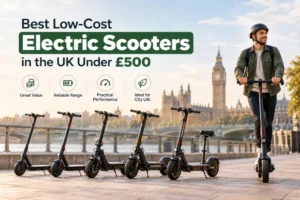




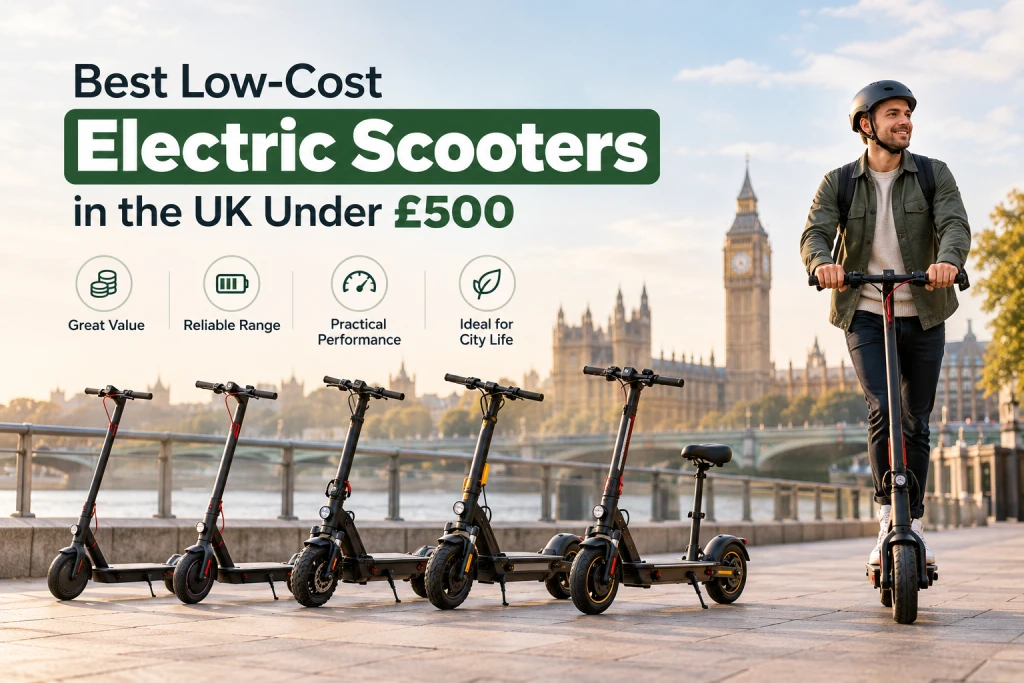
£500 puts a lot of electric scooters within reach. The trick is knowing which features you actually need.
If the scooter is only going to cover a couple of miles to the station, local errands, or a short trip across town, a £170–£250 model may do the job.
The calculation changes if you’re carrying more weight, riding hills every day, or need enough battery for a longer commute. In those cases, buying the cheapest scooter you can find can leave you with the wrong machine for the job.
This guide compares the low-cost electric scooter options in the Qik-Fix range, from £170 to £480, looking at what each one offers in real use and where you may need to compromise. If you’re comparing an electric scooter under £500, we’ll also cover what’s worth checking before you buy, from motor and battery capacity to tyres, brakes, weight and ongoing support.
A low purchase price is only part of the decision. Motor output, battery capacity, rider weight, tyres, brakes and scooter weight all affect how the machine performs in everyday use. Parts availability and support matter too, particularly once consumable components wear or an electrical issue develops.
Quick Comparison: 6 Scooters Under £500
| Model | Price | Claimed range | Top speed | Weight | Best suited to | Key trade-off |
| Scootflow NS9400 | £170 | Up to 22 miles (35 km) | Not stated | 15 kg | Short, simple trips | Basic specification, no motor figure listed |
| J03 Pro | £240 | 16–19 miles (25–30 km) | 15–19 mph (25–30 km/h) | 12.5 kg | Lightweight urban use | Smaller battery and motor |
| J01 | £370 | 31–34 miles (50–55 km) | 28 mph (45 km/h) | 23.6 kg | Hills, comfort, heavier riders | Heavier to carry |
| H14 | £400 | 28–31 miles (45–50 km) | 28 mph (45 km/h) | 29.2 kg | Uneven surfaces, larger wheels | 29.2 kg, hard to carry |
| J11 MAX | £450 | 31–34 miles (50–55 km) | 34 mph (54.7 km/h) | 23.6 kg | Power, comfort, seated riding | Heavy, stays at home and work |
| J15 Max | £480 | 28–31 miles (45–50 km) | 31 mph (50 km/h) | Not stated | City and light off-road use | Most expensive in this group |
Range figures are the manufacturer’s claims. The speeds above are what the scooters can do on private land, not what’s legal on a public road (more on that below).
The bigger difference is what you need the scooter to do. A cheaper model can make sense for a short, flat trip where portability matters more than range. If you’re covering longer distances or dealing with hills, spending closer to £500 gives you more useful performance.
We’ll look at each scooter in detail next, including what the specifications mean once you start riding.
Top Rated Adult Scooters Under £500
Scootflow NS9400 – £170
At the lower end of this group, the Scootflow NS9400 keeps the upfront cost down. That suits short local journeys on fairly flat routes, where the scooter won’t be pushed hard every day.
It has 8.5-inch solid tyres with front suspension, a 10.4Ah battery and a claimed range of up to 35 km (about 22 miles), depending on rider weight, road conditions and riding mode. It weighs 15 kg, folds in about three seconds and supports riders up to 120 kg. An LED display and Bluetooth app control lights, cruise control and zero-start mode.
Solid tyres remove puncture risk, though they cushion rough surfaces less than pneumatic tyres. Real-world range will be shorter than the claim if you ride hills or at higher speeds.
J03 Pro – £240
A daily trip to work puts more emphasis on convenience. The scooter needs to fold easily, be light enough to move around, and have enough battery for the journey home.
The J03 Pro uses a 350W motor and a 36V 10.4Ah battery with 8.5-inch explosion-proof tyres. The listed range is 25–30 km (16–19 miles), with a speed of 25–30 km/h (15–19 mph) and 6–8 hours to charge. It weighs 12.5 kg and carries up to 120 kg. Braking is a rear disc brake plus electronic power-off braking, and it has an IPX5 waterproof rating.
At 12.5 kg it’s the lightest scooter in this guide, which is useful if it regularly goes upstairs or into a car boot. The smaller battery and motor leave less room for hills, longer commutes and heavier loads.
Check the rider limit and the availability of replacement tyres, charger and brake parts before buying.
J01 – £370
Hills and heavier loads are where extra motor power earns its place. A more powerful scooter accelerates more confidently and holds performance better on inclines, provided the rider stays within the weight limit.
The J01 uses an 800W motor and a 48V 15Ah battery with 10-inch off-road inflatable tyres. Its listed range is 50–55 km (31–34 miles) and top speed is 45 km/h (28 mph). It has front and rear dual suspension, double disc brakes, an IPX5 waterproof rating and a maximum rider weight of 150 kg. It weighs 23.6 kg.
The 150 kg limit is among the highest in this guide. At 23.6 kg, though, it’s a scooter that stays at home and work rather than going up the stairs every evening. Claimed range will drop with hills, speed and temperature, and as a privately owned scooter it can only be ridden on private land with the landowner’s permission.
Check the brakes, tyres and charger support before buying.
H14 – £400
Heavier riders and rough surfaces change the priorities again. A larger wheel and a sturdier frame can matter more than the lowest price.
The H14 uses a 750W motor, a 48V 18Ah battery and 14-inch pneumatic tyres on a steel frame, with front suspension and dual disc brakes. The listed range is 45–50 km (28–31 miles), top speed is 45 km/h (28 mph) and the maximum load is 120 kg. It takes 8–10 hours to charge, has an IPX5 rating and weighs 29.2 kg.
The big pneumatic tyres smooth out uneven ground, but they need regular pressure checks and can puncture. At 29.2 kg this is a scooter that stays at ground level rather than going upstairs, and the claimed range will fall with hills, speed and rider weight. As a privately owned scooter, it can only be ridden on private land with the landowner’s permission.
Check the rider limit, tyre availability and charger support before buying.
J11 MAX – £450
Rough surfaces and longer rides are where suspension and a seat start to matter.
The J11 MAX uses a 1600W motor and a 48V 18Ah battery with 10-inch off-road tyres, dual suspension, a seat and double disc brakes. The listed range is 50–55 km (31–34 miles), top speed is 54.7 km/h (34 mph) and the maximum load is 150 kg. It has an aluminium folding frame, an IPX5 waterproof rating and weighs 23.6 kg.
That puts it level with the J01 on weight, so the same question applies: is the extra power solving a problem on your route? The 150 kg rider limit is among the highest in this guide, but the claimed range will still drop with hills, speed and temperature. Like the H14, it can only be ridden on private land with the landowner’s permission.
Check the brakes, tyres and charger support before buying.
J15 Max – £480
Sitting at the top of this group, the J15 Max is for riders who want power and suspension without going past £500.
The Freeboy J15 Max has a 1600W motor and a 48V 18Ah battery with 10-inch off-road tyres and dual suspension. It’s listed with a top speed of 50 km/h (31 mph), a range of 45–50 km (28–31 miles) and a 20° incline rating. Dual disc brakes, LED lights and turn signals are included, with an IPX5 waterproof rating and a 120 kg load limit. Charging takes 8–10 hours.
The product page doesn’t list the weight, so confirm it before you plan to carry it anywhere. Claimed range and hill performance will both be lower with a heavier rider. It’s also a private-land scooter only.
Check the rider limit, tyre availability and charger support before buying.
Which Electric Scooter Is Best for a Low Price?
The cheapest scooter isn’t automatically the best buy. Start with the journey the scooter needs to handle:
- Short, flat trips: A lighter, lower-cost scooter such as the Scootflow NS9400 or J03 Pro can be enough. You won’t necessarily benefit from paying for a larger battery or more motor power.
- Daily commuting: Look for a balance between range, tyres, braking and weight. A scooter that’s easy to carry but needs charging halfway through your routine isn’t much of a saving.
- Hills or heavier loads: Motor output and the manufacturer’s rider limit become more important. The J01 and J11 MAX both list a 150 kg limit.
- Longer journeys or rough ground: Look for a larger battery or bigger tyres, such as the J01, H14 or J11 MAX, but leave some margin between the claimed range and your actual distance. Speed, hills, rider weight, temperature and tyre pressure all reduce usable range.
The best low-cost option is the one that covers your normal journey comfortably without paying for performance you won’t use.
What Makes a Cheap Electric Scooter Expensive to Own?
The price you pay for the scooter is only part of the cost. Once you start riding it regularly, a few parts will need attention.
- Battery: Capacity drops over time, so the scooter won’t travel as far on a full charge. Replacement batteries can be expensive, so check that one is available for the model you’re buying.
- Tyres: Everyday rides wear them down. Keep them at the right pressure and replace them when the tread or condition becomes a problem. Pneumatic tyres can also pick up punctures.
- Brakes: Pads and other braking components wear with use and may need adjustment or replacement.
- Charging system: A damaged charger, charging port or loose connection can leave a perfectly good scooter unable to charge. These are worth checking on an older or used model.
- Electrical parts: The controller, display, wiring and motor all work together. A fault in any of them can affect how the scooter starts, accelerates or runs.
Qik-Fix in Coventry sells the scooters it repairs, so a fault is diagnosed before any part is replaced. On a budget model, swapping the wrong part can cost nearly as much as fixing the real problem. See our repair service.
None of this means a cheap scooter will automatically cost more to maintain. A more expensive scooter can have its own repair costs too. The better question is how easy it is to get the parts and support you need when something eventually goes wrong.
Are E-scooters for Adults Legal in the UK?
A scooter can be perfectly suitable for an adult and still not be legal to ride on a public road.
Privately Owned Scooters
In Great Britain, privately owned e-scooters cannot currently be ridden in public. That includes roads, pavements and cycle lanes.
You can ride a privately owned scooter on private land if you have the landowner’s permission. Taking it onto a public road or pavement can result in a fine, penalty points, and the scooter being seized.
So if you’re buying an electric scooter for a daily road commute, don’t assume that a model being sold in the UK makes that use legal. Every scooter in this guide is a private-land scooter.
Rental Scooters
Rental e-scooters work differently. They are part of government-approved trials and can be used in participating areas under specific conditions.
Rental scooters can generally be ridden on roads, except motorways, and on cycle lanes. They cannot be ridden on pavements. The rental operator provides the required third-party insurance, and riders need the appropriate UK driving licence.
What About 15.5 mph and 30 mph Scooters?
The 15.5 mph figure you’ll often see is linked to the rules for rental e-scooter trials. It isn’t a blanket speed limit that makes a privately owned scooter legal on public roads.
The same applies to faster scooters. Several models in this guide, including the J01, H14, J11 MAX and J15 Max, are listed at 28–34 mph. A higher top speed doesn’t change the legal position for private ownership.
Rules can change, so check the current GOV.UK e-scooter guidance before riding.
What Is the Best Budget Electric Scooter in the UK?
If you’re trying to keep the price down, it helps to understand how the range breaks down.
The Scootflow NS9400 is the entry point, aimed at short, simple trips. The J03 Pro adds a 350W motor while staying very light. The J01, H14, J11 MAX and Freeboy J15 Max step up to bigger batteries, larger tyres and suspension, with the J11 MAX and J15 Max offering the most motor power under £500.
That doesn’t mean one model is automatically the right choice. Look at the specific scooter you’re buying. Check its battery size, motor, rider limit, tyres and brakes. Then look at something that’s easy to overlook when comparing prices: can you get the parts and support later?
A scooter is going to need maintenance at some point. The brand name matters, but the support behind the particular model matters too.
Where to Buy a Low-Cost Electric Scooter
The lowest price you find online isn’t always the cheapest way to own the scooter.
A marketplace can give you plenty of choice and some very low prices, but support can depend on the individual seller. Buying from a local specialist is worth considering if you plan to keep the scooter for a while.
Qik-Fix stocks scooters in Coventry and repairs what it sells, with technical help available after the warranty ends. Stock changes, so call us on +44 7308 575219 or check the product page before you visit.
Frequently Asked Questions
Q1. Which electric scooter is best in low price for adults?
Start with the journey rather than the price. A lighter, lower-cost scooter can work well for short flat trips, while regular hills, longer distances or a heavier rider may call for more battery capacity and motor power.
Q2. What is the cheapest and best e-scooter?
The cheapest scooter isn’t always the best value. Check what you’re getting for the money, including the battery, brakes, tyres, rider limit and availability of replacement parts.
Q3. Can you ride a budget electric scooter on the road in the UK?
Not if it’s a privately owned e-scooter. In Great Britain, private e-scooters cannot currently be ridden on public roads, pavements or cycle lanes. They can be used on private land with the landowner’s permission.
Q4. How long does a cheap electric scooter battery last?
Most lithium-ion scooter batteries are rated for around 300–500 full charge cycles before capacity drops noticeably. Heavy loads, hills, heat and poor storage shorten that, so range can fall sooner for some riders than for others.