




You’re riding your usual route when you squeeze the brake lever for a turn and notice it doesn’t feel quite right.
Maybe the lever comes much closer to the handlebar than it normally does. Maybe you hear a light scrape-scrape as the wheel turns.
Don’t ignore the change. A brake that feels different can have a few causes. The cable may simply have become a little loose, a brake pad may have moved out of position, or something may be worn and need replacing.
If the brake feels soft or spongy, especially on a bike with hydraulic brakes, it may need more than a simple adjustment.
The first step is working out what has changed. Once you know that, you can decide what needs adjusting and when it’s better to leave the repair to a bike mechanic.
How Do You Know What Needs Adjusting?
Start with something simple: how does the brake feel when you use it?
If the lever is coming much closer to the handlebar before the bike starts slowing down, the brake cable may have picked up some slack. A small adjustment can often take care of that. But if the brake pads are worn, tightening the cable won’t solve the real problem.
If you hear a light scraping when the wheel turns, spin the wheel and listen for where it’s coming from. A quick rub in one spot may mean the brake has shifted slightly. If it keeps rubbing all the way around, the brake may not be releasing properly.
Squealing or uneven braking can also be a sign that the pads aren’t sitting quite right or have become worn or contaminated.
And if a hydraulic brake feels soft or spongy instead of firm, don’t try to fix it by simply tightening something. There could be a problem inside the braking system that needs proper attention.
The important thing is not to keep adjusting until something feels different. Find out what has changed first, then make the adjustment that matches the problem.
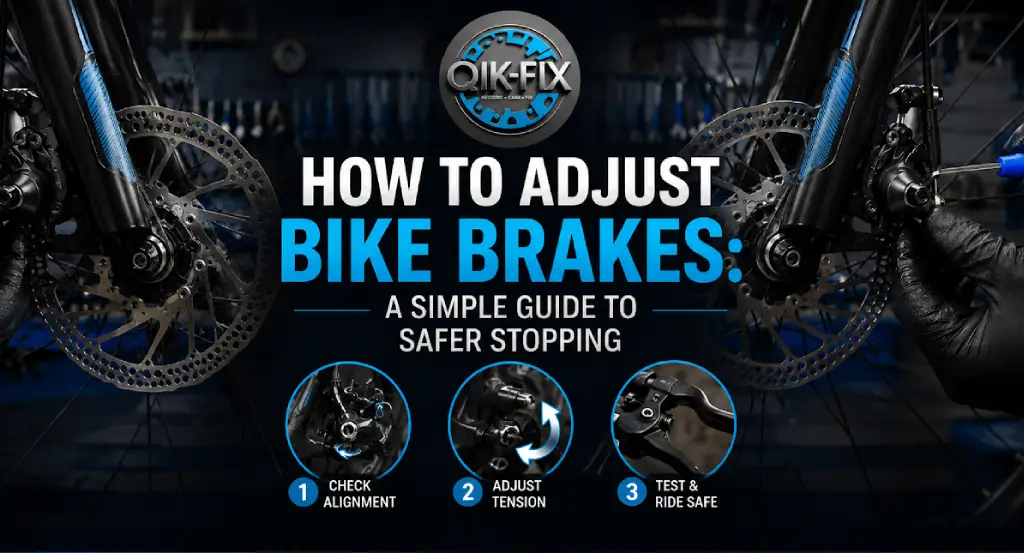
How to Adjust Bike Brake Cable Tension
If the brake lever feels loose but the cable and brake pads look okay, you may only need to take up a little slack.
Look for the barrel adjuster where the brake cable enters the brake lever or brake itself. Its job is simple: it takes up a small amount of slack in the cable, so the brake starts working sooner when you pull the lever.
Turn the adjuster a little, then squeeze the brake lever again. Does the brake engage sooner? Good. Now release the lever and spin the wheel. It should turn freely rather than feeling like the brake is still touching it.
Still feels loose? Make another small adjustment and check again.
Don’t keep turning the adjuster just to make the lever feel tighter. Too much tension can leave the brake partly engaged, which creates drag and wears the brake parts unnecessarily.
If you’ve made a few small adjustments and the lever still pulls too far, stop there. The cable may need to be tightened properly, the pads may be worn, or there may be another problem that isn’t going to disappear with another turn of the adjuster.
Also Read: Why You Shouldn’t Ignore Small Changes in Your E-Bike
How to Stop Bike Brakes From Rubbing
You spin the wheel and hear that familiar scrape-scrape even though you’re not touching the brake. It’s annoying, but don’t start turning bolts at random.
First, see if you can work out where the rubbing is coming from. If you have rim brakes, watch the brake pads as the wheel turns. Is one pad sitting closer to the rim than the other? If so, the brake may simply be sitting slightly off-centre.
A small adjustment can bring the pads back into an even position.
With mechanical disc brakes, the same idea applies. If the brake is sitting slightly out of line with the disc, one pad can keep touching it as the wheel spins. Make a small adjustment, spin the wheel again, and listen.
You’ll know pretty quickly if you’ve moved in the right direction.
A little rubbing shouldn’t be ignored, especially if it continues after you’ve made a sensible adjustment. Constant contact creates drag and gradually wears the brake components.
If you can’t see what’s causing the rubbing, or it remains after adjustment, that’s a good point to have the brake checked rather than keep guessing.
How to Adjust Brake Pads
If your brake pads aren’t sitting evenly, you’ll usually notice it when you look at the wheel. One pad may sit closer to the rim, or it may touch the tyre instead of the part of the rim designed for braking.
On rim brakes, the pad should meet the rim, not the tyre. If it’s sitting too high, it can damage the tyre. If it’s sitting too low, it won’t grip the rim properly.
Before moving the pads, check how much material is left. A very thin pad, a cracked pad, or a pad with a shiny surface from wear won’t improve just because you move it. The same goes for a pad that’s picked up oil or other contamination.
Don’t adjust a worn pad to try to get more life from it. If the material has reached the end of its usable life, replacing it is the right fix. That way, you’re solving the problem rather than simply moving it around.
Do E-Bike Brakes Need Different Attention?
There’s a simple reason to pay a little more attention to the brakes on an e-bike: you’re stopping more weight. The bike itself is heavier, and once you add a rider, that extra weight gives the brakes more work to do every time you slow down.
So if your e-bike suddenly takes longer to stop, the lever feels different, or the braking feels uneven, don’t just put it down to the bike being electric. It’s worth finding out what’s changed.
There’s also a small detail around the brake lever that’s easy to miss. Some e-bikes use the lever to tell the motor when you’re braking. If you’re working around the lever or cable, take care not to disturb any wiring or small sensor attached to it.
And if your hydraulic brake lever feels soft or spongy, that’s not something to fix by simply tightening things. It may need bleeding or a closer inspection.
If the problem doesn’t go away after a basic check, e-bike brake repair is better than continuing to adjust parts without knowing what’s causing the issue.
Also Read: Electric Scooter Not Charging
Is It an Adjustment Problem or a Brake Repair?
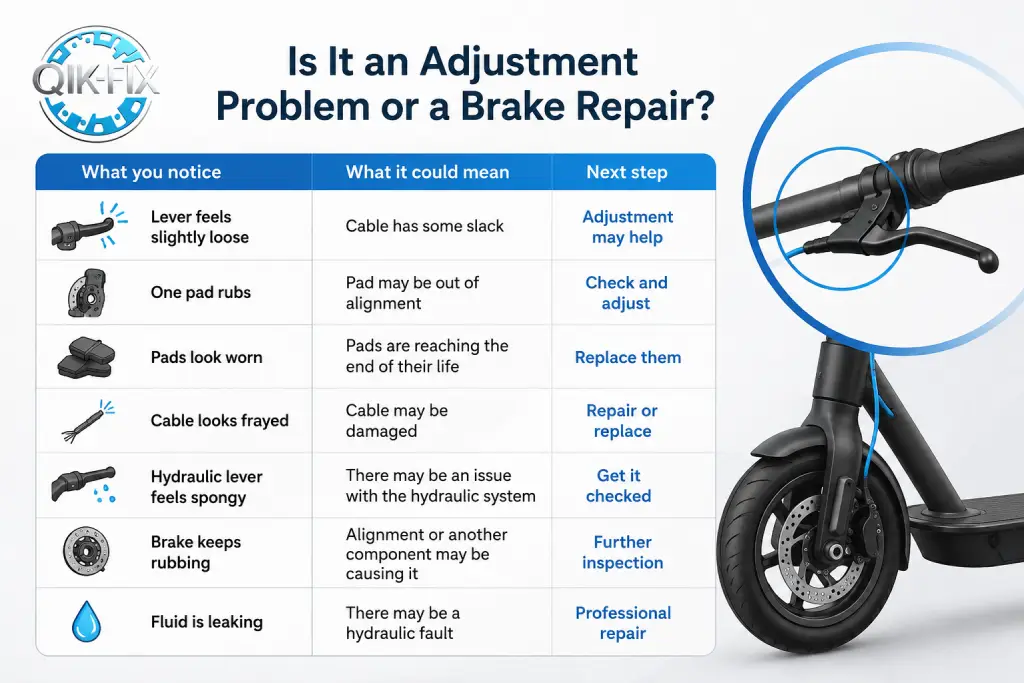
Not every brake problem means you need new parts. Sometimes, a small adjustment is all it takes. The key is figuring out why the brake feels different before replacing anything.
| What you notice | What it could mean | Next step |
| Lever feels slightly loose | Cable has some slack | Adjustment may help |
| One pad rubs | Pad may be out of alignment | Check and adjust |
| Pads look worn | Pads are reaching the end of their life | Replace them |
| Cable looks frayed | Cable may be damaged | Repair or replace |
| Hydraulic lever feels spongy | There may be an issue with the hydraulic system | Get it checked |
| Brake keeps rubbing | Alignment or another component may be causing it | Further inspection |
| Fluid is leaking | There may be a hydraulic fault | Professional repair |
This is especially important when looking for electric scooter and e-bike repairs. A quick check can often tell you if the brake simply needs adjusting or if something actually needs replacing.
When Should You Get Your Brakes Professionally Checked?
If your brakes don’t feel quite right, don’t ignore it. Sometimes a quick adjustment is all they need, but if that doesn’t help, it’s best to have them checked properly rather than keep guessing.
You should get professional help if:
- Your brakes still feel weak after an adjustment
- The brake lever feels soft or spongy
- You notice brake fluid leaking
- A brake cable looks frayed or damaged
- The brake pads look very worn
- The rotor or wheel rim is damaged
- The brakes keep rubbing even after you’ve tried to fix them
- You’re not sure what the problem is
Brakes are too important to take chances with. At Qik-Fix Bikes & Scooters, we can find the cause of the problem and let you know what needs doing before you spend money replacing parts you may not need.
Book a diagnostic or speak with our team to get your bike or scooter checked.
And if you’re thinking beyond the repair, it might be time for an upgrade.
If your e-bike is struggling to give you the range or power you need, or your scooter is simply getting old, Qik-Fix has new options worth checking out, including:
Explore the latest Qik-Fix arrivals and find the upgrade that fits your ride.
FAQs
Q1. How do I adjust bike brakes that are too loose?
Start by finding out why they feel loose. It could be simple cable slack, worn brake pads, or another issue. A small adjustment may fix it, but don’t keep tightening things if the braking still feels weak.
Q2. Why are my bike brakes rubbing?
Rubbing can happen when a brake pad is sitting out of position or the brake isn’t properly aligned. If you’ve adjusted the position and it still rubs, there could be a problem with another component that needs checking.
Q3. How often should I check my bike brakes?
There’s no single schedule that works for every bike. Make regular condition checks part of your routine, and always check the brakes when they start feeling different, noisy, weak, or uneven.
Q4. Can I adjust hydraulic bike brakes myself?
Basic alignment may be straightforward, but hydraulic repairs are a different matter. If the lever feels spongy or the system needs bleeding, it’s better to have someone familiar with hydraulic brakes handle it.
Q5. How do I know if my bike brake pads need replacing?
Look for obvious wear, poor braking, or pads that appear damaged or contaminated. If there’s very little pad material left, adjustment won’t solve the problem. The pads need replacing.
Q6. Are e-bike brakes different from normal bike brakes?
They can be. E-bikes are heavier and can put more demand on the brakes, and different models use different braking systems. That’s why a brake issue shouldn’t always be treated exactly like one on a standard bike.
Q7. Can I adjust electric scooter brakes myself?
It depends on the scooter and its brake system. A simple adjustment may be manageable, but damaged cables, persistent rubbing, weak braking, or hydraulic issues are better left to a professional. If you’re unsure what’s causing the problem, an inspection is the safer starting point.